Testing innovative solutions for historic windows: update from Eurac Research
As part of the CALECHE project, Work Package 4 focuses on developing tools and technologies to improve the performance of solutions for historic buildings. One of these innovations is the WUM-box (Window U-value Measurement box) — a prototype designed to measure the thermal transmittance (U-value) of historic windows directly on site.
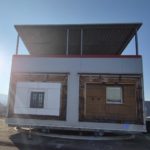
The prototype has been progressively improved throughout the project. Initial measurement campaigns were carried out in laboratory conditions using two controlled environments simulating interior and exterior temperatures. More recently, testing moved closer to real-life conditions at Eurac Research’s Façade System Interactions Lab (FSIL) in Bolzano, Italy. This unique facility allows researchers to work with removable façades and evaluate different orientations, creating highly realistic testing scenarios.
Thanks to this infrastructure, the team introduced an additional experimental step: measuring a historic window from the Donner House case study in Visby, Sweden. A replica matching the geometry and materials of the original window was constructed and shipped to Eurac Research. Several solutions are being tested alongside it, including a 1990s double-glazed window, vacuum glazing, and innovative insulated shutters.


To ensure reliable measurements, the window frame is installed into a 30 cm EPS wall, used as a “standardized” support element. The wall is fixed to the structure and oriented in the desired direction, typically north to limit direct solar radiation. The WUM-box is applied to the inside and, using heaters and ventilation, a temperature delta is imposed between the air in the box and the outside of the window, which remains subject to the actual uncontrolled climate. At the same time, the gradient between the WUM-box and the heated internal chamber, maintained at around 20 °C, is minimized.
Beyond comparing thermal performance, this campaign is essential for assessing the reliability of the WUM-box in near real-world conditions. The test will allow for the analysis of critical aspects such as the effect of diffuse radiation, the impact of shading using tarpaulins, the influence of orientation, and the effectiveness of the heating systems currently in use. These variables increase the complexity of the set-up but make the study particularly relevant and useful from the point of view of thermophysical research applied to building heritage.